Social Work and the Architecture of Liberation
Social Work and the Architecture of Liberation
From Maroon Communities to Radical Social Transformation
I. Before There Was a Profession
Before there were social workers, there were people who refused to abandon one another.
Before there were professional codes of ethics, clinical assessments, diagnostic manuals, government grants, nonprofit organizations, and evidence-based interventions, there were communities confronting the conditions of their own survival. They organized food, shelter, education, protection, healing, cultural transmission, conflict resolution, and resistance.
More importantly, they did not always wait for the institutions dominating them to become kinder.
Sometimes they built elsewhere.
Consider the Maroons.
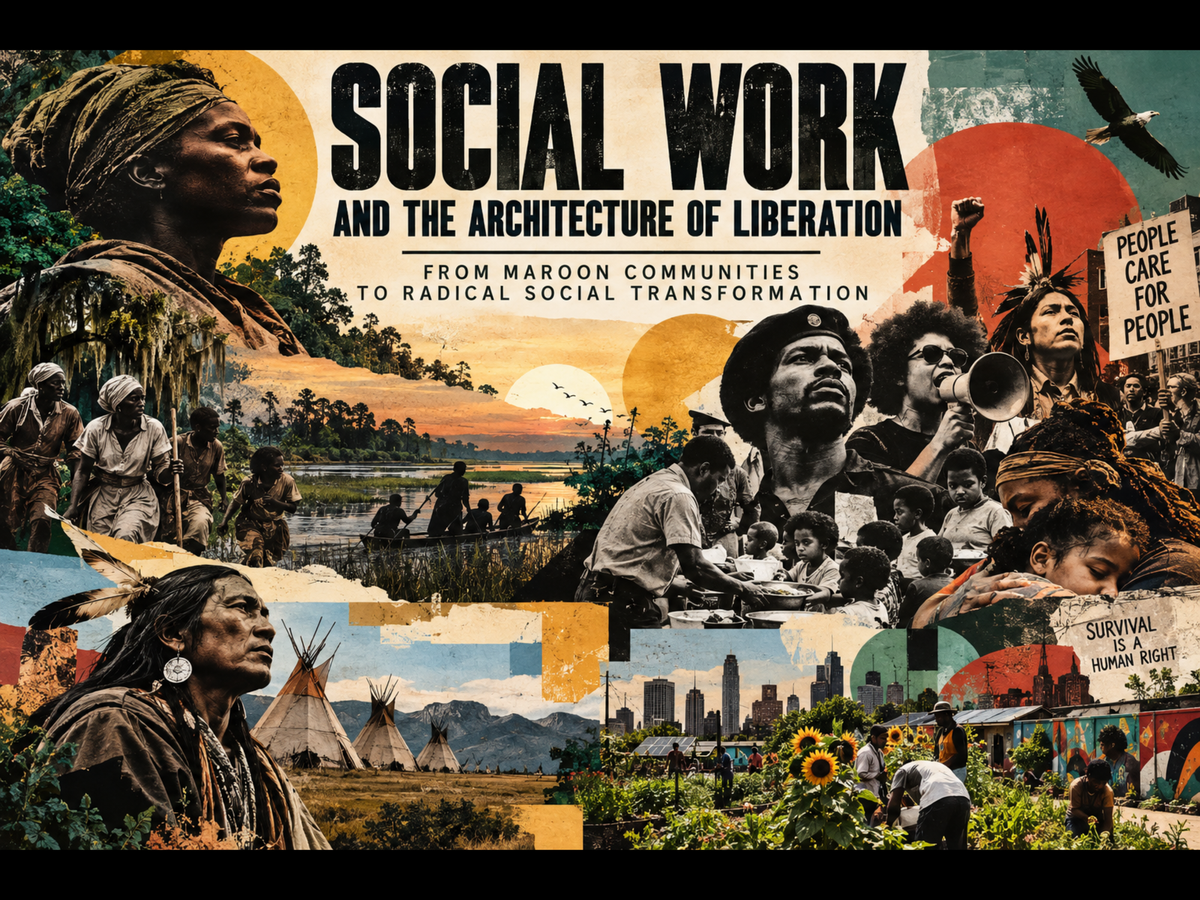
Across the Americas—including within the territories that became the United States—enslaved Africans escaped plantations and created communities beyond, between, and sometimes directly against the boundaries of colonial authority. Maroon communities developed throughout the Caribbean and Latin America, but marronage was also deeply embedded in North American history.
In the swamps, forests, borderlands, and Indigenous territories of what became the United States, people escaping slavery established settlements, joined existing communities, formed alliances, and constructed new social worlds. The Great Dismal Swamp, stretching across what is now Virginia and North Carolina, sheltered generations of people who escaped slavery and established communities in terrain that slaveholders and colonial authorities struggled to penetrate. In Spanish Florida, Africans escaping British slavery formed communities and military alliances, including relationships with Seminole people that contributed to the emergence of the Black Seminoles. Fort Mose, established near St. Augustine in the eighteenth century, became the first legally sanctioned free Black settlement in what is now the United States.
These histories complicate any simple boundary between African resistance and Indigenous resistance. In parts of North America, resistance to slavery, settler expansion, and Indigenous dispossession became physically and politically entangled. Africans escaping bondage sometimes found refuge among Indigenous peoples. Communities exchanged knowledge, formed families, fought alongside one another, and developed new cultural formations under the pressure of colonial violence.
These relationships were neither universal nor uncomplicated. Some Native people and nations also participated in slavery. Maroon communities themselves contained contradictions, conflicts, and hierarchies. Liberation does not require us to invent morally perfect ancestors.
What matters here is something else.
They built.
Marronage was not simply escape.
Escape describes movement away from something.
Marronage could become the construction of something beyond it.
A person escaping slavery had solved one immediate problem while creating a thousand others. Where would food come from? Where could people sleep? How would children be protected? How would knowledge be transmitted? How would illness and injury be treated? How would conflict be resolved? How could a community remain connected to people still living under slavery? How could it defend itself when the dominant society inevitably attempted to recover the bodies, labor, territory, and authority it believed belonged to it?
Answering those questions required social organization.
It required relationships.
It required systems.
But systems are not synonymous with domination.
This distinction is foundational to everything that follows.
Human beings require coordination. We require ways of distributing resources, resolving disagreements, transmitting knowledge, caring for children, supporting people through illness and disability, responding to danger, and making decisions that affect one another.
None of those requirements inherently demands domination.
The mistake is imagining that because human beings require systems, they therefore require systems in which some people possess enduring authority over the lives of others.
Marronage exposes that mistake.
People subjected to domination did not merely demand better treatment from the institutions dominating them. Sometimes they withdrew their bodies, labor, relationships, knowledge, and participation from those institutions and redirected those capacities toward another social arrangement.
They created possibility outside the boundaries their oppressors had declared inevitable.
That possibility should matter enormously to social work.
A plantation owner might have improved the food available to enslaved people, reduced their working hours, permitted greater family contact, or provided treatment for their injuries. Such interventions might have reduced immediate suffering. They would not, however, have addressed the fundamental relationship responsible for that suffering.
The Maroons challenged the relationship itself.
Imagine evaluating the plantation through the framework of contemporary social services. We might document food insecurity, inadequate housing, exposure to violence, family separation, psychological trauma, and insufficient access to healthcare. We might develop interventions, establish measurable objectives, refer individuals to appropriate services, document compliance, and produce extensive reports demonstrating improvement in selected outcomes.
We might become exceptionally skilled at treating the wounds produced by the plantation.
And leave the plantation standing.
Worse, we might eventually become necessary to its continued operation.
The comparison is deliberately uncomfortable. Contemporary social service institutions are not slave plantations, and collapsing their enormous historical differences would obscure rather than illuminate the argument. The point is methodological.
A systems analysis cannot stop when it identifies the injury.
It cannot stop when it identifies the person experiencing the injury.
It cannot even stop when it identifies the institution immediately responsible for treating the injury.
It must continue outward until it encounters the relationships that repeatedly produce the injury.
And then it must ask a question that professional helping institutions frequently avoid:
Does this relationship need to be repaired?
Or does something else need to be built?
This is where marronage offers social work something considerably more radical than a historical example of resilience.
Resilience can become a dangerous word when separated from power. It can describe the remarkable capacity of people to survive, adapt, recover, and transform. But institutions can also celebrate resilience precisely because resilient people are capable of surviving conditions those institutions have no intention of changing.
There is nothing inherently liberatory about becoming better at surviving harm.
Marronage points toward another possibility.
Not merely resilience within the existing system.
Construction beyond it.
The Maroons were not social workers in the modern professional sense, and we should not retroactively recruit them into a profession that did not exist. Their experience belongs instead to a much older history of collective survival, resistance, mutual responsibility, and liberation.
But perhaps social work has been looking in the wrong direction for its intellectual and ethical ancestors.
Perhaps our history should not begin only when wealthy philanthropists, religious organizations, governments, and universities began professionalizing assistance to poor people.
Perhaps it should also begin with the people who fed one another without permission.
The people who sheltered fugitives.
The people who carried knowledge through attempted erasure.
The people who created communities in swamps because the swamp offered more freedom than civilization did.
The people who discovered that the master’s institution was not the boundary of human possibility.
And the people who understood something social work still struggles to confront:
sometimes helping people survive a system is necessary.
Sometimes helping them navigate it is necessary.
Sometimes fighting to change it is necessary.
And sometimes we must build something else.
II. The Professionalization of Help
Social work enters this history carrying a contradiction.
At its most expansive, the profession recognizes that human suffering emerges from relationships among individuals, families, communities, institutions, economies, cultures, political structures, and physical environments. Social workers are taught to understand people within systems rather than reducing human problems to individual pathology.
This should be a profoundly disruptive idea.
If the environment participates in producing suffering, then changing the person while leaving the environment untouched cannot constitute an adequate intervention.
Yet social work has repeatedly been asked to do precisely that.
The professionalization of helping created expertise, standards, bodies of knowledge, ethical expectations, and institutions capable of mobilizing substantial resources. These developments produced real benefits.
Professionalization also changed the relationship between the person offering assistance and the person receiving it.
Help increasingly became something administered.
Someone became the helper.
Someone else became the client.
Someone determined eligibility.
Someone assessed functioning.
Someone established treatment goals.
Someone documented compliance.
Someone decided whether progress had occurred.
Someone controlled access to resources the other person needed.
The architecture of domination can survive remarkably progressive language.
Authority does not disappear because the person exercising it has been trained to exercise it compassionately.
This is one of social work’s most uncomfortable inheritances.
The profession has participated in systems of child removal, forced assimilation, institutionalization, segregation, compulsory treatment, correctional control, moral regulation, and the surveillance of poor families. At various moments, professionals acting under the language of welfare have helped determine which families were respectable, which mothers were adequate, which behaviors were normal, which people were employable, which homes were suitable, and which people required institutional control.
This history cannot be dismissed as the primitive period before social work discovered its ethics.
The underlying relationship persists wherever one person controls resources another person needs and calls the resulting interaction empowerment.
Social work therefore occupies an extraordinary position.
It frequently stands between people and the institutions governing access to the necessities of life.
Housing.
Food.
Healthcare.
Income.
Education.
Family integrity.
Freedom.
The social worker may be compassionate, conscientious, exhausted, underpaid, and genuinely committed to the person sitting across from them.
The structure remains.
This is why radical social work cannot simply mean producing more radical social workers.
Changing the beliefs of the person occupying a position of institutional authority does not necessarily change the position.
The architecture itself must become an object of practice.
III. Survival Pending Revolution
This is where the Black Panther Party becomes essential to the story.
The Panthers understood something that political movements sometimes forget and social service institutions sometimes refuse to acknowledge: people cannot postpone eating until liberation arrives.
Children are hungry now.
People are sick now.
Families need transportation now.
People caught in the criminal legal system need assistance now.
Communities experiencing state violence cannot survive on promises about the society that might someday exist.
The Panthers responded through what became known as Survival Programs.
The most famous was the Free Breakfast for Children Program, but the broader network included health clinics, food distribution, transportation, education, legal assistance, and other community programs.
This was direct service.
But it was not merely direct service.
And that distinction may contain one of the most important lessons radical social work can recover.
The Panthers did not imagine that feeding a hungry child abolished the political and economic conditions producing hunger.
They fed the child anyway.
The meal addressed the immediate wound while the organization remained capable of naming the weapon.
This collapses a false choice that continues to haunt social work.
Direct service or systems change.
Individual intervention or political action.
Helping people survive or transforming society.
The Panthers demonstrated that these activities can occupy the same political practice.
Feed the child.
Treat the illness.
Drive someone to visit an incarcerated family member.
Teach the history.
Build the institution.
Organize the community.
Challenge the conditions.
None requires pretending the others can wait.
The crucial difference lies in where power accumulates.
A conventional service organization can unintentionally reproduce dependency by concentrating expertise, funding, decision-making, and institutional legitimacy within itself. The organization becomes indispensable while the community remains positioned as the recipient of its expertise.
A liberation-oriented organization asks a more dangerous question:
What if successful intervention makes the professional less necessary?
What if resources, knowledge, infrastructure, and decision-making capacity move outward rather than upward?
What if the purpose of helping is not to create better clients but stronger communities?
IV. Self-Determination Means Building
The American Indian Movement pushes this question further because Indigenous resistance confronts not merely exclusion from American institutions but the historical imposition of those institutions upon peoples who already possessed their own systems of governance, kinship, education, spirituality, justice, and collective care.
Colonization frequently presents domination as assistance.
The colonizer destroys or suppresses existing institutions and then offers services to address the resulting devastation.
Children are separated from communities and then professionals study the resulting family dysfunction.
Land is taken and economic systems disrupted, and then poverty becomes an individual social problem.
Cultural practices are suppressed, and later professionals develop culturally competent interventions for populations experiencing alienation.
Communities are deprived of authority, and then empowerment becomes a service delivered to them.
There is an almost unbearable circularity to it.
AIM and the broader movements for Indigenous sovereignty force social work to confront the limits of inclusion as a political objective.
Inclusion into what?
Sometimes justice requires access to institutions from which people have been excluded.
But inclusion cannot be the outer boundary of liberation.
A person can be successfully integrated into a harmful system.
A community can become better represented inside an institution that continues to concentrate authority elsewhere.
Diversity can change who administers domination without changing the relationship of domination itself.
Self-determination demands something more substantial.
It requires the capacity of communities to construct, govern, modify, and sometimes abandon the institutions shaping their lives.
Education provides one example.
The radical possibility is not simply making an imposed educational institution more culturally responsive.
It is communities possessing meaningful authority to determine what education is, what knowledge matters, how children learn, who teaches them, what relationships education should cultivate, and what purposes education should serve.
The same question can be asked of healthcare.
Housing.
Food systems.
Restorative practices.
Disability support.
Mental health.
Substance use services.
Child welfare.
And social work itself.
The question changes from:
How can we deliver better services to this community?
to:
What does this community need in order to build and control the systems through which it cares for itself?
That is a very different profession.
Perhaps eventually it ceases to resemble a profession at all.
Perhaps social work at its most radical does not seek an ever-expanding jurisdiction over human suffering.
Perhaps it works toward distributing the knowledge, resources, relationships, and material capacity currently concentrated within professional institutions.
Perhaps success is not measured by how many people enter services.
Perhaps success includes how many services become unnecessary.
How many gates disappear.
How much knowledge escapes professional custody.
How many decisions return to the people who must live with their consequences.
How much institutional territory can be converted into commons.
And how many communities acquire the material capacity not merely to survive the systems surrounding them, but to build beyond them.
Because a Band-Aid has value.
When someone is bleeding, use it.
But social work cannot congratulate itself for distributing Band-Aids while standing in a room where the bullets keep flying.
Eventually, a systems profession has to ask who manufactures the bullets, who profits from them, who determines where they are fired, why the same communities keep getting hit—
and what we could build together if healing were no longer organized around surviving the wound.