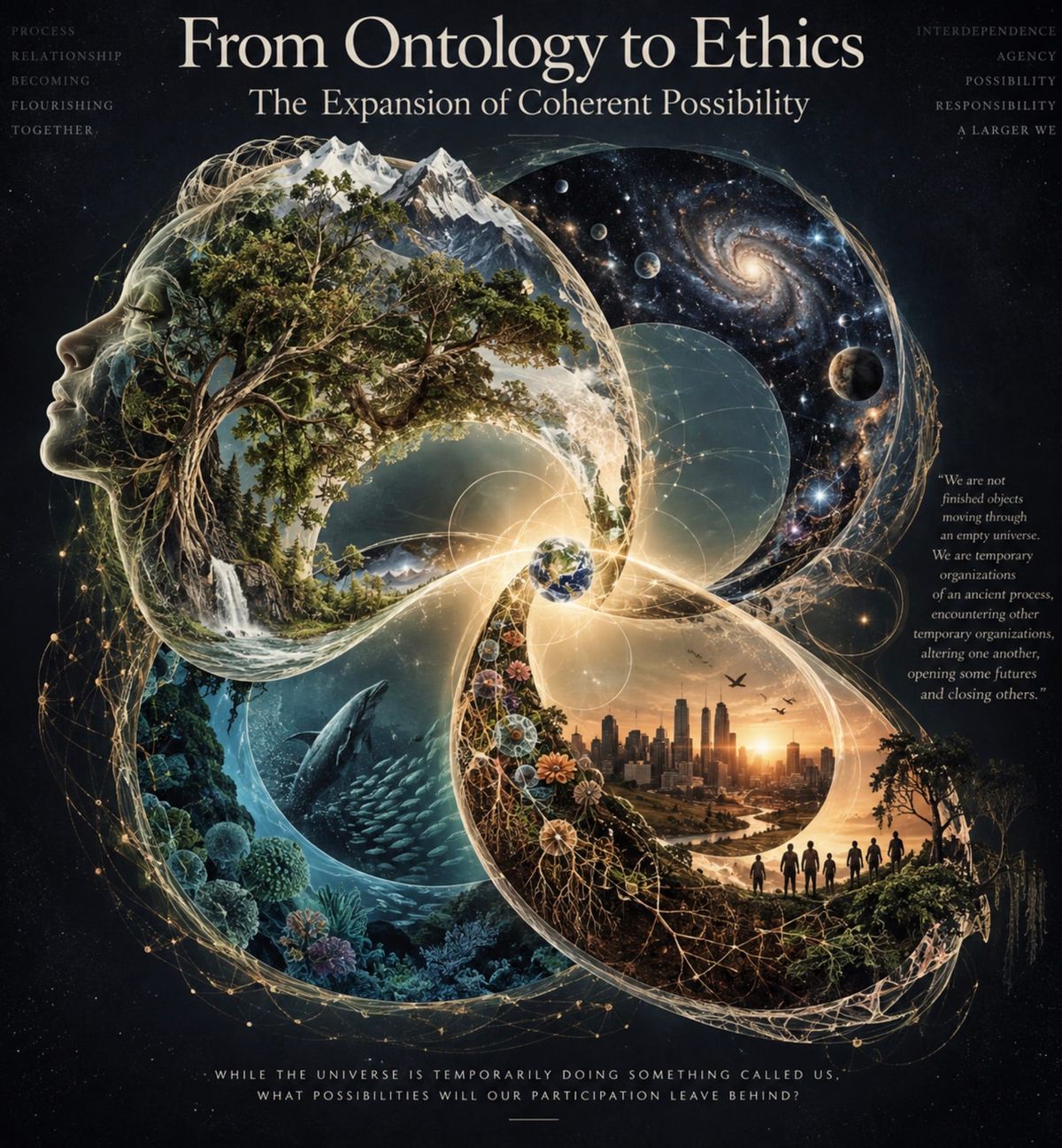
From Ontology to Ethics; The Expansion of Coherent Possiblilty
Perhaps we have been asking the wrong question.
For a very long time, humans of the Western conceptual paradigm have tried to determine what things are.
What is life?
What is consciousness?
What is the self?
Where does one thing end and another begin?
What separates organism from environment, human from animal, living from nonliving, intelligence from mechanism?
We like categories because categories make the universe hold still.
But the universe does not hold still.
The calcium becomes bone for seventy years and eventually becomes something else. Water becomes blood and leaves again. Oxygen enters, carbon leaves. Bacteria become part of the processes we call ourselves. Food becomes thought, movement, sperm, milk, muscle, shit, memory.
Nothing stays put.
More importantly, nothing happens alone.
Every one of these transformations depends upon other transformations. Bone requires minerals formed in ancient geological processes, food grown through sunlight and soil, blood circulated by organs assembled from other matter, oxygen produced by organisms we did not create. What appears, from a distance, to be a single process turns out, on examination, to be an intersection of innumerable others.
And yet something persists.
That may be where we should begin.
Not with things.
With processes.
And not with isolated processes.
With processes within processes, crossing through one another, temporarily becoming one another, producing conditions in which still other processes become possible.
Disclaimer
This is not an attempt to define reality.
It could not be.
Whatever reality may be in its entirety, we encounter it through nervous systems shaped by processes we barely understand, using languages inherited from other people, carrying histories we did not witness, observing scales of time and relationship our minds were never built to contain. The processes in which we participate extend backward beyond memory and outward beyond perception, intersecting other processes in arrangements of such complexity that none of us could comprehend more than fragments.
Even the categories used throughout this argument—process, relationship, self, possibility—are tools fashioned from inside the thing they attempt to describe.
The map is being drawn from within the territory.
So what follows is not a claim about what reality ultimately is.
It is an observation about how we appear to participate in it.
And wherever we look closely, participation seems to reveal the same troublesome fact:
Nothing happens alone.
The Ocean Is Dropping
There is a beautiful image in Sikh thought: the drop exists in the ocean, and the ocean exists in the drop.
We usually imagine ourselves differently.
There is a universe, and somewhere inside it there is a planet. On that planet there are organisms. Inside some organisms there is consciousness. Somewhere inside that consciousness sits a little sovereign entity called me, looking outward at everything that is not me.
But try finding the boundary.
The oxygen outside your body is supposedly not you. You inhale. Seconds later it participates in the processes keeping you alive.
The apple is not you.
Then you eat it.
Bacteria are not you, except that vast communities of microorganisms participate continuously in digestion, immunity, metabolism and development. Human life as we know it does not occur without them.
Language is not you. Yet almost every word through which you understand yourself came from other minds.
Your body is not materially identical to the body you inhabited years ago.
Your memories change.
Your beliefs change.
Your cells change.
Your relationships change.
And still you say:
I.
Perhaps the mistake is imagining that something underneath all this transformation must remain unchanged for the word I to be legitimate.
Consider a wave.
A wave unquestionably exists.
You can see it, measure it, surf it, be knocked down by it.
But pick up the wave.
Where is it?
The water comprising it changes continuously. Its shape changes. Its position changes. Its energy passes into other processes.
The wave is not a substance added to the water.
The wave is what the water is doing.
But even that is incomplete.
The wave is also what gravity is doing with water. What wind is doing with a surface. What the shape of an ocean basin is doing with energy arriving from somewhere else. What the moon may be doing through tides. What distant weather did hours or days before.
There is no wave alone.
The thing we name wave is where processes meet.
Perhaps we are something similar.
Perhaps a person is not fundamentally a thing possessing a history.
Perhaps the person is the history: a temporarily persistent organization of relationships extending through time.
The universe, in this picture, is not fundamentally a warehouse containing objects.
It is happening.
And what we call objects may be relatively stable patterns within that happening.
A storm.
A flame.
A forest.
A body.
A civilization.
A conversation.
A self.
All real.
None permanent.
None independent.
Impermanence is not unreality.
It seems that independence and permanence may be the unreality here.
A song does not become unreal because it ends, nor does the violin cease to matter because the music also required a bow, a musician, an acoustic space, a listener and a tradition through which its sounds became intelligible.
To exist may not mean to exist separately.
It may mean to participate.
Time Is Not What Happens to Us
This changes the problem of time.
We normally imagine time as something happening to otherwise stable things.
There is me, and then time acts upon me.
There is a tree, and time ages the tree.
There is a mountain, and time erodes the mountain.
But remove change completely.
No atom moves. No photon propagates. No organism metabolizes. No thought proceeds. No clock oscillates. No memory forms.
How would we establish that a second had passed?
Every clock we have ever built measures one process against another process.
Perhaps time is not merely the container in which processes happen.
Perhaps time and process are inseparable.
And then identity becomes stranger.
If identity is continuity through transformation, time is not the enemy gradually destroying the self.
Time is part of what makes a self possible.
There can be no continuity without difference between states.
There can be no persistence without something through which persistence occurs.
There can be no memory without a before.
There can be no anticipation without an after.
There can be no becoming without change.
You aren’t simply something that changes.
Change is temporarily doing something we call you.
And because no change occurs in isolation, you are not even one process moving independently through time. You are a convergence of processes carrying different histories and operating at different scales: biological, geological, ecological, linguistic, familial, cultural, technological, economic.
Some began billions of years before your birth.
Some will continue after your death.
For a while they intersect here.
The ocean isn’t merely made of drops.
For a while,
the ocean is dropping.
Relationship Comes Before Independence
This makes the mythology of the completely autonomous individual increasingly difficult to sustain.
No organism creates itself.
A human begins through other humans, develops inside another organism, emerges dependent upon caregivers, breathes an atmosphere created partly by other organisms, eats organisms, hosts organisms, acquires language from other humans, inherits genes from innumerable ancestors, and learns how to interpret existence through relationships with minds that existed before it.
Even rebellion requires something against which to rebel.
The independent individual is profoundly interdependent.
That is not weakness.
It is existence.
But we can go further.
Perhaps relationship is not something that happens between already completed entities.
Perhaps entities themselves emerge through relationships.
The forest is not simply a collection of trees. Trees alter soil, fungi move nutrients, insects pollinate plants, animals distribute seeds, decomposition makes future growth possible, water moves through root and atmosphere, and each process changes the conditions under which the others continue.
Remove enough relationships and eventually there is no forest left to call a collection.
The body is not simply a collection of cells.
The mind is not simply a collection of neurons.
The city is not simply a collection of buildings.
The community is not simply a collection of people.
The conversation is not simply two finished minds exchanging packages of information.
Relationships create states that none of the participants could produce independently.
More than that: relationships alter the participants themselves.
The tree changes the soil that changes the tree.
The river shapes the land that redirects the river.
The language shapes the speaker who changes the language.
The child changes the parent who changes the child.
The reader changes the meaning of the text, and the text changes what the reader becomes capable of thinking next.
Cause does not simply travel in straight lines.
Processes loop.
They intersect.
They amplify and constrain one another.
They become conditions for one another’s continuation.
I experienced a version of that while developing this argument, over many years of conversations, reading, and observing the world around me.
The parts of the processes temporarily organized as me interacted with the parts temporarily organized as everything else.
Something happened.
A thought produced another thought. A formulation reorganized an earlier formulation. A correction changed the available direction of the conversation. Concepts that had existed separately—identity, time, process, relationship—began organizing themselves into something more coherent.
Neither participant simply transferred a finished object called an idea to the other.
The relationship changed the participants.
And by changing the participants, it changed what became possible next.
That gives us our bridge.
Coherent Possibility
What does it mean for a process to flourish?
We could say pleasure.
But pleasure is not sufficient. A process can experience pleasure while destroying the conditions of its own continuation.
We could say survival.
But mere survival is not sufficient either. A human being can be kept alive while being deprived of virtually everything we would recognize as a meaningful life.
We could say freedom.
But unlimited possibility is incoherent. A system without constraint is not necessarily free. Without constraint there is no structure at all.
A language without constraints communicates nothing.
A wave requires water, energy, gravity and physical law.
A living organism survives precisely because some possibilities are excluded while others remain available.
So perhaps flourishing is neither maximum order nor maximum possibility.
Perhaps it lies in their relationship.
Flourishing may be an increase in coherent possibility.
Enough structure to persist.
Enough openness to become.
But coherent possibility cannot belong entirely to an isolated process, because there are no isolated processes.
My possibilities depend upon conditions produced by others.
Their possibilities may depend upon mine.
A forest’s possibilities depend upon soil, water, fungi, microbes, insects, climate, fire and time. A child’s possibilities depend partly upon caregivers, food, shelter, language, education, community and political conditions. A river’s possibilities depend upon rainfall, geology, vegetation and what humans decide to put in its path.
Possibility is relational.
This means flourishing cannot simply be the accumulation of options by one entity. A process that expands its own possibilities by systematically destroying the possibilities upon which it depends may be powerful for a time, but it is not flourishing in any durable sense.
It is consuming its own conditions of possibility.
That formulation matters.
Randomness provides possibility without coherence.
Totalitarian control provides coherence of a kind by destroying possibility.
A flourishing process occupies the extraordinary territory between them: organized enough to maintain continuity while remaining open enough to develop states that do not yet exist.
A healthy forest is not one in which every organism behaves identically.
Its resilience comes partly from diversity, redundancy, adaptation and relationships among different forms of life.
A healthy conversation does not require agreement.
It requires enough common structure for disagreement to produce something other than noise.
A healthy person is not someone who has eliminated contradiction, appetite, dependency, vulnerability or uncertainty.
Perhaps health is better understood as possessing—and participating in relationships that provide—enough resources, safety, agency and openness to continue becoming.
This leads directly from ontology into ethics.
Agency
If the self is a process, then agency does not require an invisible commander sitting somewhere inside the skull.
Agency can be understood relationally.
Agency is the increasing capacity of a process to participate in determining its own subsequent states.
Not absolute control.
Absolute control is fantasy.
None of us chose our genome.
None chose the century into which we were born.
None invented the language through which our earliest thoughts became thinkable.
None chose every injury, opportunity, relationship, loss, economic system or historical circumstance that shaped the field of possibilities available to us.
But within constraint, processes can acquire greater or lesser capacities to affect what happens next.
Education can expand that capacity.
Food can.
Housing can.
Rest can.
Community can.
Information can.
Mobility can.
Art can.
Love can.
A wheelchair can.
Medication can.
Money can.
A library card can.
A union can.
A friend can.
A conversation can.
Notice what this list reveals.
Agency is not the opposite of dependence.
Agency is often produced through interdependence.
The wheelchair does not make someone independent of the material world; it creates a new relationship with it. Education does not make a mind independent; it connects that mind to generations of accumulated thought. A union does not give a worker agency by separating the worker from others, but by coordinating many people’s capacities. Language itself expands what an individual can think precisely because it is inherited from a community.
What we call independence may often be a particularly successful arrangement of dependencies.
Each relationship may alter the field of possible subsequent states.
That gives us a different understanding of freedom.
Freedom is sufficient coherent possibility to participate meaningfully in one’s own becoming.
And now the opposite becomes visible.
Domination
Domination is not merely someone telling another person what to do.
It is the systematic narrowing of another process’s field of possible states for the benefit of some other process or structure.
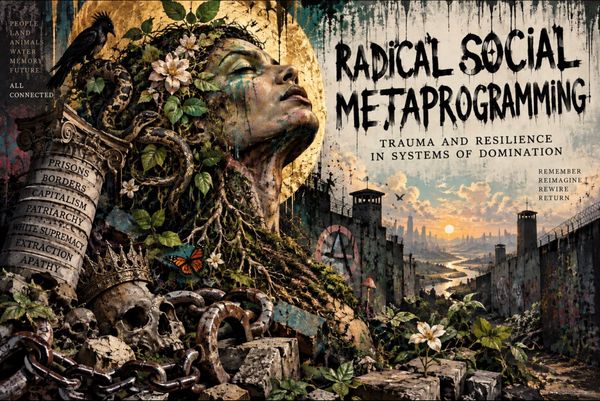
Consider incarceration.
A prison does not merely move a body from one geographical location to another.
It radically compresses possibility.
Where you may go.
When you may sleep.
What you may eat.
Whom you may touch.
What objects you may possess.
What information you may access.
When you may speak.
Whether you may leave.
But if processes are intertwined, the compression does not stop at the prisoner’s skin.
Every individual separated and controlled this way participates in family and community processes. Their removal changes children, partners, parents, neighborhoods, economies and future relationships. The people operating the institution are changed by their participation in it. Resources flow toward some institutions and away from others. Possibility is redistributed throughout a network.
Domination propagates.
Poverty does something structurally related without requiring walls.
A person technically possesses thousands of legal possibilities that are functionally unavailable because they lack money, transportation, housing, healthcare, time or social permission.
Formal possibility is not coherent possibility.
This distinction matters enormously.
A person sleeping under a bridge and a billionaire may possess the same constitutional right to publish a newspaper.
Only one can purchase the newspaper.
Money is therefore not merely wealth.
It is stored possibility.
Enough money can purchase time, movement, education, lawyers, privacy, medical care, political access, communication and escape from consequences.
Extreme concentrations of wealth become extreme concentrations of possibility.
And because possibilities are relational, one actor’s expanding possibility can be purchased through another actor’s contraction.
The factory owner gains the possibility of greater profit by reducing the worker’s wages.
The colonizer gains land by eliminating the Indigenous person’s possibility of remaining upon it.
The slaveholder’s economic possibilities depend upon the enslaved person’s radical deprivation of agency.
The polluter preserves profitable possibilities while narrowing the future possibilities of people, animals, ecosystems and generations who may never know who made the decision.
Power can therefore be understood partly as the capacity to shape the possibility-space of other processes.
The Corporate Machine
This is where the corporation becomes philosophically interesting.
A corporation is itself a persistent process.
People enter and leave it.
Executives die.
Shareholders sell.
Buildings change.
Products change.
Yet the corporation persists through legal identity, contracts, capital, records, procedures and relationships.
It is almost an ideal demonstration that identity does not require material continuity.
General Motors today contains essentially none of the human beings who constituted General Motors a century ago.
Yet legally and socially we recognize a persistent entity.
The corporation is a wave.
But it is a wave to which we have given bank accounts, property rights, political influence, lawyers and extraordinary longevity.
We have also constructed corporate law in ways that can separate ownership from significant portions of the enterprise’s financial liability.
The result is a process capable of accumulating enormous resources across generations while individual humans move through it.
Capital becomes institutional memory.
Wealth becomes durable possibility.
And concentrated possibility becomes power over other people’s possible futures.
This is why corporate political involvement matters.
Lobbying matters.
Regulatory capture matters.
Campaign spending matters.
Media ownership matters.
None is merely about money changing hands.
They are mechanisms through which one organized process participates disproportionately in determining the subsequent states available to other processes.
And because those other processes are intertwined, an intervention in one place may propagate far beyond its apparent target.
A labor policy changes a household.
A household changes a child.
A child’s circumstances alter education.
Education alters future work.
Work alters health, housing, political participation and the possibilities available to another generation.
There is no clean edge at which the consequence stops.
Attention Is a Field of Possibility
Now consider propaganda.
Propaganda isn’t merely making people believe something false. It is arranging their informational environment so that certain conclusions become easier to reach and alternatives become harder to imagine.
Under our framework, this becomes a direct intervention into coherent possibility.
Thought itself requires available material.
Most cannot seriously consider possibilities we have been prevented from perceiving.
Control the information environment and you alter the possibility-space of thought.
That is why censorship matters.
It is why concentrated media ownership matters.
It is why algorithms matter.
It is why education matters.
It is why language matters.
It is why burning books has accompanied so many authoritarian projects.
And it is why fascism is not merely a collection of terrible opinions.
Fascist politics systematically reorganizes possibility.
It narrows who may belong.
It narrows acceptable identities.
It narrows political alternatives.
It narrows legitimate sources of information.
It narrows the boundaries of citizenship.
It narrows the permissible understanding of history.
It narrows empathy.
Eventually it may narrow the physical possibilities available to targeted populations: where they may live, whether they may work, whether they may reproduce, whether they may remain in the country, whether they may remain alive.
This machinery is older than the word fascism.
Colonialism used it.
Slavery used it.
Settler states used it.
Racial caste systems used it.
Empires used it.
Fascism assembled and intensified existing technologies of domination rather than inventing domination from nothing.
Its violence is preceded by an attack upon possibility. It is an iterative process.
Before people can be removed from society physically, societies are taught to remove them imaginatively from the community of people whose futures matter.
Disability and the Violence of Normalcy
The same framework gives us another way to think about disability.
A society can look at a disabled body and locate the entire problem inside that body.
This person cannot climb the stairs.
This person cannot work eight uninterrupted hours.
This person cannot process information in the expected way.
This person cannot tolerate the environment we have constructed.
Therefore the person is deficient.
But put in a ramp and a previously impossible future becomes possible.
Change the schedule and another appears.
Provide communication support and another appears.
Allow rest.
Provide transportation.
Remove sensory barriers.
Provide accessible housing.
Stop demanding that every human organism perform according to the same industrial rhythm.
Suddenly what appeared to be an intrinsic incapacity is revealed partly as a relationship between a particular process and an environment designed around different processes.
The ramp makes something else visible as well.
Neither ability nor disability exists entirely inside the individual.
Capacity emerges from relationship.
Change the relationship between body and environment and the field of possibility changes with it.
The ethical question changes.
Instead of asking:
What is wrong with this person?
we can ask:
What possibilities have we unnecessarily denied this person?
That is disability justice expressed through process ontology.
Harm Reduction
And here our philosophy runs directly into harm reduction.
Conventional approaches to addiction often demand transformation before protection.
Stop using.
Become sober.
Become compliant.
Become responsible.
Become employable.
Become the person we believe you should be.
Then we will help preserve your life.
Harm reduction reverses the ethical order.
A person does not have to become who you want them to be before their life is worth protecting.
That proposition fits our ontology perfectly.
If a person is an unfolding process rather than a finished moral object, preserving life preserves possibility.
Keeping someone alive keeps tomorrow available.
Naloxone is not merely reversing an overdose.
It is reopening a future that was about to become impossible.
A clean syringe preserves possibilities.
Housing preserves possibilities.
Food preserves possibilities.
Human connection preserves possibilities.
And each preserved possibility extends beyond the individual.
A life continued remains capable of affecting other lives. A relationship continues. A child may still have a parent. A friend may still have a friend. A community retains one of the processes participating in its becoming.
This is not an argument that a person’s worth depends upon usefulness to others.
It is the opposite.
It is an acknowledgement that no life can be reduced to a closed ledger of individual outcomes because no life occurs alone.
No one guarantees what someone will become.
That is precisely the point.
Ethics should not require knowing what someone will become before deciding whether their becoming deserves protection.
Harm reduction does not demand purity.
It protects possibility.
Ecology Without Human Exceptionalism
And now we have to abandon one final conceit.
There is no reason coherent possibility should end at the boundary of the human species.
The forest is a process.
The river is a process.
The atmosphere is a process.
Soil is an astonishing community of processes.
Weather is process.
Stone is process occurring at temporal scales our nervous systems find difficult to appreciate.
Mountains rise and erode.
Continents migrate.
Carbon circulates.
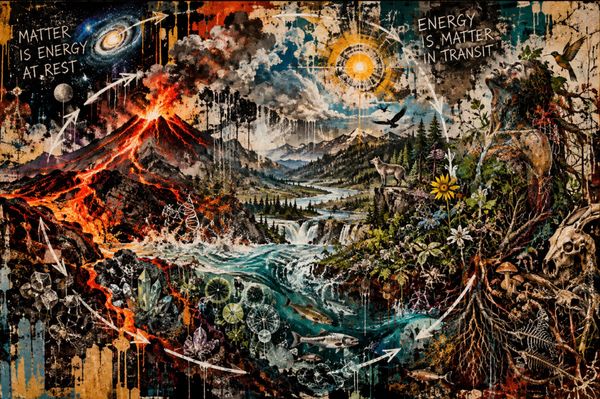
Water moves through ocean, cloud, blood, root, river, ice and atmosphere.
And notice again: none of these merely exists beside the others.
The river becomes the cloud.
The cloud becomes rain.
Rain enters soil.
Soil feeds root.
Root becomes tree.
Tree enters atmosphere.
Atmosphere enters lung.
Lung returns carbon.
Death becomes soil.
The categories remain useful.
The boundaries remain porous.
The distinction between living and nonliving remains useful for many purposes.
It does not grant humanity metaphysical ownership of everything outside the category.
The human organism exists only because countless nonhuman processes continue.
Destroying an ecosystem therefore does more than kill individual organisms.
It destroys relationships.
And because relationships generate possibilities, destroying relationships destroys fields of future possibility.
Species that might have evolved do not.
Relationships that took millions of years to develop terminate.
Human communities lose possible futures.
Future generations inherit a narrower world.
Ecological destruction is possibility destruction across time.
This gives environmental ethics a foundation deeper than save nature because humans need it.
Nature does not require usefulness to humans before its continuation matters.
We are not outside the ocean evaluating whether the ocean deserves protection.
We are something the ocean is doing.
Liberation
And finally we arrive at liberation.
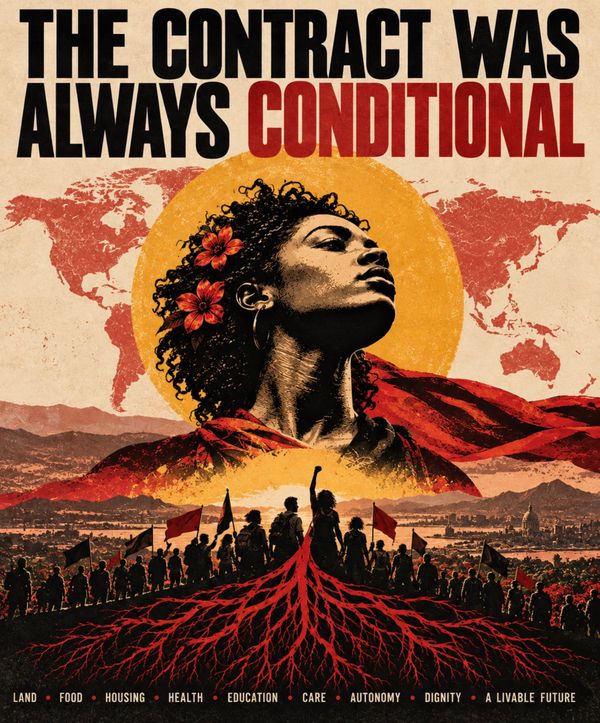
If domination is the systematic narrowing of coherent possibility, liberation cannot simply mean removing all constraint.
That would be incoherence.
Nor can liberation mean forcing everyone toward some predetermined ideal state.
That merely replaces one domination with another.
Liberation is more difficult.
Liberation is the expansion and restoration of coherent possibility: increasing the capacity of people and communities to participate meaningfully in determining what they may become.
That means food.
Housing.
Healthcare.
Education.
Mobility.
Information.
Rest.
Safety.
Community.
Ecological stability.
Political participation.
Freedom from arbitrary confinement.
Freedom from domination.
But if agency is relational, liberation cannot mean making everyone independent of everyone else.
There is no such condition.
Liberation instead requires transforming the relationships of dependence we inevitably inhabit: from coercive dependence toward reciprocal dependence, from imposed vulnerability toward shared responsibility, from relationships that extract possibility toward relationships that generate it.
The goal is not independence.
It is interdependence without domination.
And it requires uncertainty.
Because if we already know exactly what liberated people must become, they are not liberated.
We must protect futures we cannot predict.
That may be the deepest ethical consequence of process ontology.
A thing can be evaluated according to what it is.
A process must also be approached according to what it might become.
And we cannot know.
The child may become something unimaginable to the parent.
The recovering addict may relapse and survive.
The incarcerated person may emerge changed in ways no risk assessment predicted.
The disabled person may flourish when the environment stops demanding conformity.
The damaged ecosystem may regenerate differently from what existed before.
The conversation may produce an idea neither participant possessed when it began.
The future is not valuable because we know what it contains.
The future is valuable because it contains possibility.
The Ethics of the Ocean
Perhaps this is where the Sikh image becomes useful again.
The drop is in the ocean.
The ocean is in the drop.
But now we can understand the image more radically.
The drop does not merely occupy the ocean.
Its existence as a drop depends upon the oceanic processes producing it.
The ocean, meanwhile, is not some separate thing standing behind its constituent processes.
The ocean exists through them.
Part and whole are not identical.
But neither is complete without relationship.
If existence is a relational process, then the flourishing of one process cannot be completely separated from the conditions surrounding it.
My possibilities alter yours.
Yours alter mine.
And neither set of possibilities began with us.
The worker and employer.
Prisoner and guard.
Child and parent.
Human and forest.
River and city.
Reader and writer.
Not equal relationships.
Not identical processes.
Not interchangeable experiences.
But relationships nonetheless, producing subsequent states neither side produces entirely alone.
That means ethics cannot merely ask:
What am I permitted to do?
It must also ask:
What possibilities does my participation create or destroy?
Does this relationship enlarge another being’s capacity to become, or unnecessarily narrow it?
Does this institution preserve possibility or consume it?
Does this technology distribute agency or concentrate it?
Does this economic arrangement create coherent possibilities broadly, or accumulate enormous possibility for a few by extracting it from everyone else?
Does this punishment protect future possibilities, or merely destroy them?
Does this story help people perceive more of reality, or make alternatives impossible to imagine?
Does this way of living leave the ocean capable of continuing to drop?
These are not instructions for achieving purity.
Purity belongs to static things.
We are processes.
Worse—or better—we are entangled processes.
There is no action that begins and ends entirely within ourselves.
We inherit consequences we did not cause.
We create consequences we will never see.
We depend upon beings we will never know.
Others will live inside conditions we helped create without knowing our names.
We will contradict ourselves.
We will consume.
We will damage.
We will misunderstand.
We will sometimes narrow possibilities while trying to expand them.
There is no position outside the system from which we can remain uncontaminated.
The ethical task is therefore not innocence.
It is participation.
Attention.
Correction.
Repair.
Reciprocity.
The continual attempt to create conditions in which more of existence can participate meaningfully in what comes next.
And perhaps that is flourishing.
Not happiness.
Not victory.
Not immortality.
Not perfect freedom.
Simply an increase in coherent possibility.
Enough coherence to remain.
Enough possibility to change.
Enough relationship to matter.
Enough agency to participate.
Enough reciprocity that one process need not diminish another merely to continue.
Enough uncertainty that something genuinely new can still happen.
We are not finished objects moving through an empty universe.
We are temporary organizations of ancient processes, themselves composed of and dependent upon other processes, encountering still more temporary organizations and becoming conditions of one another’s existence.
We do not merely touch and then separate unchanged.
We enter one another’s histories.
The wave does not own the ocean.
The wave is not separate from the ocean.
The ocean is not merely the background against which the wave occurs.
For a while, the ocean becomes this wave.
The wave is real.
It changes what it touches.
What it touches changes it.
And then both become something else.
Perhaps ethics begins there:
While the universe is temporarily doing something we call us, what will our participation make possible next?