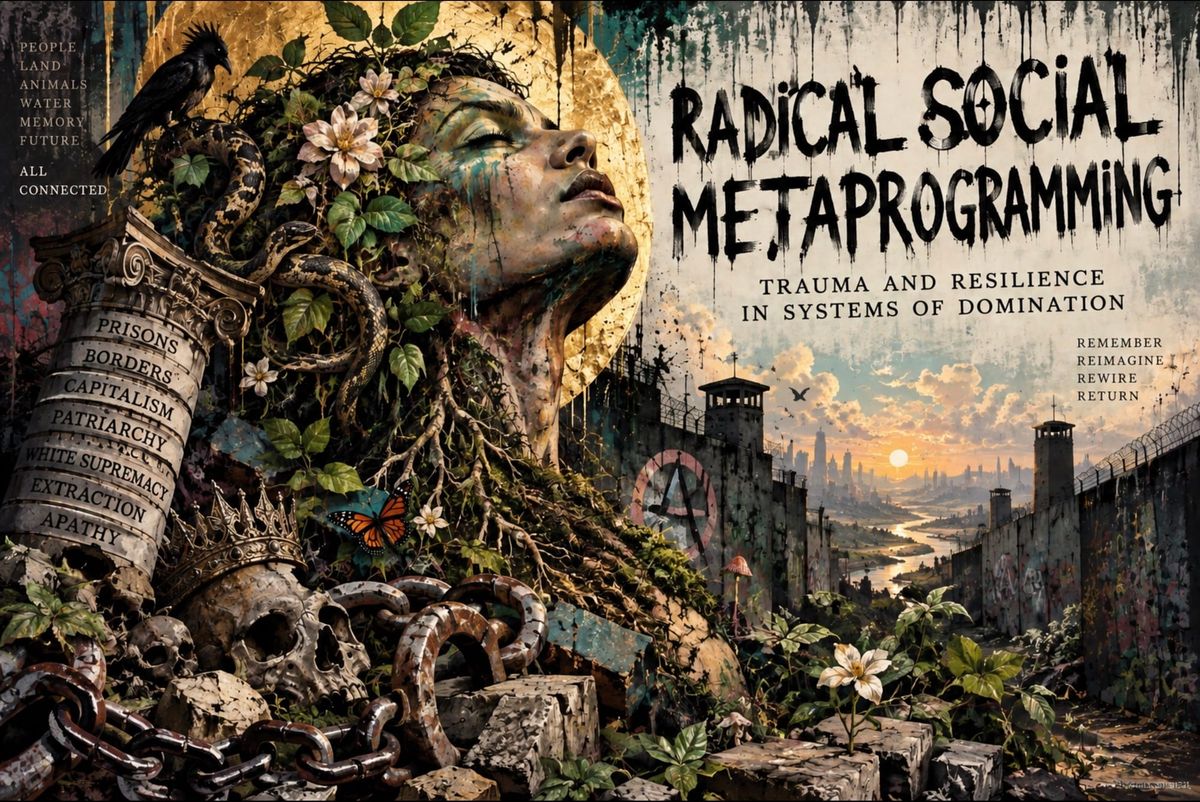
Radical Social Metaprogramming; Trauma and Resilience in Systems of Domination
Imagine a child growing up in an abusive home.
The child does not control the mortgage. They do not make the rules. They cannot replace the parent. They cannot simply announce that the household will henceforth operate according to principles of mutual respect and participatory democracy. Their world is structurally constrained by relationships of power that existed before they understood them.
So the child learns the house.
They learn which footsteps mean danger. Which subjects cannot be discussed. Which facial expression means stop talking. Which desires can safely be expressed and which must disappear. They learn when to become invisible, when to appease, when to lie, when to fight, and when to run. They learn how much of themselves can safely exist in each room.
These adaptations are not irrational. Within the environment that produced them, they may be remarkably intelligent.
The problem comes when the rules of the house become confused with the rules of reality.
This is simply how the world works.
Perhaps this is one of trauma’s most consequential effects. Trauma does not merely cause suffering. It can narrow the field of perceived possibility.
There were always possibilities outside the house.
The child simply had little access to them.
This distinction matters because human beings do not exist as isolated objects. We are processes unfolding through relationships: with families, communities, institutions, ecosystems, histories, technologies, economies, and one another. What we call a person is not a sealed container traveling through an external world. A person is continuously constituted through interactions with that world.
If flourishing can be understood as an increase in coherent possibility—an expansion of the ways a living process can continue becoming without destroying the conditions that make its becoming possible—then trauma can be understood partly as its inverse.
Trauma narrows possibility.
And domination can produce that narrowing systematically.
The House Gets Larger
A child lives inside a family, but families exist inside neighborhoods. Neighborhoods exist inside cities, economies, states, cultures, legal systems, ecological systems, and histories.
Human beings arrive in worlds whose fundamental arrangements they did not choose.
We do not choose the distribution of land into which we are born. We do not choose existing property regimes, borders, labor systems, racial classifications, gender expectations, policing institutions, educational structures, economic arrangements, or inherited ecological conditions. Long before we understand these systems, we are already learning how to survive inside them.
The comparison between an abusive household and a system of domination should not be mistaken for equivalence. A state is not a parent. An economy is not a household. Poverty is not identical to childhood abuse. Complex political institutions cannot usefully be diagnosed as though they were individual human beings.
The parallel is structural.
When a system possesses substantial power over the conditions necessary for survival, people adapt themselves to that system.
And adaptations to domination can eventually masquerade as human nature.
Competition appears inevitable in environments organized around scarcity.
Obedience appears virtuous where refusal reliably produces punishment.
Hoarding appears rational when tomorrow is insecure.
Isolation appears natural where dependence on others has repeatedly proven dangerous.
Submission can look like maturity when authority controls access to food, housing, employment, education, healthcare, freedom, or social belonging.
Helplessness can look like realism when meaningful decisions are consistently made somewhere else.
The child learns the house.
The community learns the system.
Eventually both may have difficulty distinguishing what exists from what is possible.
The cage becomes hardest to perceive when its inhabitants have become exceptionally skilled at living inside it.
Trauma as a Contraction of Possibility
The research surrounding Adverse Childhood Experiences (ACEs) provides one empirical window into this process. ACEs include experiences such as abuse, neglect, violence, household instability, and other forms of adversity during childhood. Higher exposure to such experiences is associated, at the population level, with increased risks across physical health, mental health, relationships, education, employment, and other domains later in life.
But ACE research can be misunderstood if it becomes another mechanism for classifying damaged people.
A score is not a destiny.
More importantly, counting adversity tells only half the story.
Research into Protective and Compensatory Experiences (PACEs) asks another question: what experiences help preserve or restore healthy development in the presence of adversity?
Supportive adults matter.
Friendships matter.
Belonging matters.
Mentorship matters.
Participation matters.
Opportunities to develop competence matter.
Safe places matter.
Being taken seriously matters.
Having somewhere to go matters.
This changes the conceptual picture considerably.
The opposite of trauma is not merely the absence of trauma.
It is the presence of possibility.
Consider again the child in the abusive household.
The child may not be capable of stopping the abusive parent. But another adult can believe them. A teacher can recognize their intelligence. A neighbor’s house can become safe territory. A coach can provide consistency. A friend’s family can demonstrate that other kinds of relationships exist. A library can provide access to worlds the household cannot imagine. A community can give the child somewhere to exist where the rules of the abusive home do not constitute the whole universe.
The house remains.
But the house is no longer everything.
Something extraordinarily important has happened.
The child’s field of possibility has expanded.
From Personal Trauma to Social Trauma
Now widen the frame.
Communities can also experience repeated disruption, displacement, violence, deprivation, incarceration, ecological destruction, economic abandonment, and the destruction of institutions through which people once cared for one another.
The effects do not remain neatly contained within individual nervous systems.
When enough people are forced into survival mode, relationships themselves change. Trust becomes expensive. Time horizons contract. Institutions become suspect. Knowledge can be lost between generations. People leave. Resources disappear. Those who remain become exhausted.
Trauma becomes relational.
And because people develop inside those relationships, relational trauma can reproduce itself without requiring anyone to consciously decide to reproduce it.
The frightened parent frightens the child.
The humiliated worker humiliates someone with less power.
The institution responds to disorder with greater control.
The controlled population develops strategies for avoiding the institution.
The institution interprets avoidance as evidence that greater control is necessary.
Possibility contracts again.
This is where hierarchy becomes more than a question of who occupies which position.
Hierarchy creates chokepoints of possibility.
When access to something necessary must pass through a single authority, that authority acquires enormous power over the possible futures of everyone beneath it.
One landlord.
One employer.
One bureaucracy.
One food source.
One authority.
One expert.
One acceptable identity.
One institution capable of granting permission.
One story explaining reality.
The fewer pathways available, the greater the consequences when one pathway fails—or becomes abusive.
The Mistake of Resilience
This also forces us to reconsider what we mean by resilience.
Resilience is frequently described as an individual’s capacity to withstand adversity and recover from it. There is value in that idea, but it can become grotesque when applied without attention to the conditions producing the adversity.
A society can injure people and then congratulate those who remain productive.
A workplace can exhaust its employees and offer them mindfulness training.
A school can overwhelm children and teach them coping skills.
A community can be systematically deprived of resources and then be studied for deficiencies in resilience.
Under this formulation, resilience quietly becomes the ability to tolerate increasingly intolerable conditions.
That definition is exceptionally convenient for systems producing those conditions.
There is another possibility.
Resilience may be understood as a property of relationships.
A resilient system contains enough connection, redundancy, diversity, memory, resources, trust, knowledge, and alternative pathways that the failure of one pathway does not collapse the entire field of possibility.
The abused child becomes more resilient not because they become capable of enduring greater abuse.
They become more resilient when the abusive household becomes less capable of determining their entire future.
Someone else knows their name.
Someone else has food.
Someone else has a couch.
Someone else will answer the phone.
Someone else believes them.
There is another door.
Resilience Is Redundancy
Ecological systems give us a useful parallel.
A field containing a single genetically uniform crop may be extraordinarily efficient under predictable conditions. But efficiency and resilience are not the same thing. When conditions change, uniformity becomes fragility. As we’ve established, change is the nature of reality.
Complex living systems frequently contain what an accountant might call inefficiency: redundancy, diversity, overlapping relationships, multiple pathways, unused capacity.
Those apparent inefficiencies are often precisely what allow adaptation.
Human communities are not ecosystems in any simple one-to-one sense, but the distinction gives us something useful.
Efficiency asks:
How little redundancy can we tolerate?
Resilience asks:
How many viable pathways can we preserve?
A community in which only one person knows how to repair the generator is fragile.
A community in which six people know how to repair it is redundant.
And therefore stronger.
The same principle applies to food, transportation, housing, childcare, knowledge, healthcare, conflict resolution, communication, and human relationships themselves.
Three places where a child feels safe are more resilient than one.
Several local sources of food are more resilient than one distant source.
Knowledge distributed among many people is more resilient than knowledge monopolized by an expert.
A neighborhood whose residents know one another possesses capacities that a collection of strangers occupying adjacent buildings does not.
Resilience is not merely toughness.
It is available alternatives.
Autonomous Action
This gives radical social metaprogramming a practical dimension.
Much political imagination remains fascinated with the control room.
Who occupies the presidency?
Who controls parliament?
Who owns the corporation?
Who runs the institution?
Who writes the rules?
These questions matter. Institutions possess enormous power over material conditions. But an exclusive fixation on capturing institutional power can accidentally reinforce one of domination’s foundational lessons:
Power exists somewhere else.
Somewhere above us.
Somewhere distant.
Somewhere we must petition, capture, defeat, persuade, or wait for.
Autonomous action begins with another question:
What can we construct between ourselves right now that makes domination less necessary tomorrow?
Not merely resistance.
Capacity.
A neighborhood establishes a tool library.
One hundred households no longer need one hundred drills sitting unused in one hundred garages.
Someone starts a community garden.
It does not overthrow the global food system. It produces tomatoes.
But it also produces knowledge.
Seeds.
Soil.
Relationships.
Intergenerational contact.
Ecological literacy.
Shared work.
A place to belong.
A tiny portion of food production has moved into relationships in which the participants possess meaningful agency.
Possibility has increased.
Neighbors organize before a crisis rather than meeting for the first time during one.
Tenants learn one another’s names before the eviction notice arrives.
People learn first aid, gardening, bicycle repair, food preservation, childcare, legal observation, disaster response, conflict mediation, sewing, electrical repair, and basic construction—and teach those skills to others.
Communities create kitchens, workshops, free stores, seed libraries, childcare cooperatives, community land trusts, neighborhood assemblies, transportation networks, local media, restorative and transformative justice practices, and mutual-aid networks.
Elders know children who are not their grandchildren.
Adults know elderly people who are not their parents.
People routinely cook for one another, repair one another’s homes, share equipment, exchange skills, maintain common spaces, check on isolated neighbors, and know who needs help when the power goes out.
None of these actions individually abolishes domination.
That is precisely the point.
Neither does the safe adult in the abused child’s life overthrow the household.
They introduce another possibility.
PACEs at the Scale of Community
This is where Protective and Compensatory Experiences become particularly interesting.
What happens if we stop treating PACEs exclusively as interventions for individual children and begin examining their underlying relational logic?
Supportive relationships.
Belonging.
Mentorship.
Participation.
Opportunities for meaningful contribution.
Access to enriching experiences.
Safe and dependable people.
These are not merely psychological amenities.
They are infrastructure.
A community capable of producing them abundantly creates conditions in which trauma has fewer opportunities to become destiny.
The question therefore becomes larger than:
How do we make traumatized people more resilient?
It becomes:
What kinds of relationships make entire communities harder to traumatize?
And then:
What kinds of communities make systems of domination less capable of controlling human possibility?
This is not resilience as fortification.
It is resilience through proliferation.
More relationships.
More knowledge.
More skills.
More places to belong.
More ways to acquire necessities.
More people capable of helping.
More ways of solving problems.
More routes through the world.
The goal is not independence.
Absolute independence is another mythology of the isolated self.
Nothing living is independent.
Autonomy is better understood as a particular quality of interdependence.
The abused child becomes safer not by needing nobody.
The child becomes safer when no single relationship controls every condition necessary for existence.
The same principle scales upward.
A resilient person possesses relationships.
A resilient neighborhood possesses networks.
A resilient community possesses overlapping networks.
A resilient society contains enough distributed capacity that no single institution, authority, market, employer, ideology, or infrastructure can determine the entire field of possible life.
Autonomy is therefore not the absence of dependence.
Autonomy is interdependence without absolute dependency.
Metaprogramming the Social Environment
Now we can give the term radical social metaprogramming some teeth.
Social metaprogramming does not mean replacing one system of indoctrination with another.
Domination is already exceptionally good at telling people what to believe.
The deeper project is changing the relationships through which beliefs become plausible.
You do not convince someone that cooperation is possible by lecturing them about cooperation.
Cooperate with them.
You do not teach someone that strangers can sometimes be trusted by publishing a manifesto about social trust.
Become trustworthy.
You do not prove that resources can be held in common by winning an argument about property.
Build something held in common.
You do not teach children that adults can be safe by putting community values on a school poster.
Become adults they can safely trust.
You do not convince people that another world is possible merely by describing another world.
Create a small piece of it and invite them inside.
This is why apparently minor autonomous actions matter.
They are not miniature rehearsals for some distant revolution.
They are evidence.
Every functioning cooperative relationship introduces information into the social environment:
This is possible.
Every mutual-aid network says:
There is another pathway.
Every freely transmitted skill says:
Knowledge does not have to remain scarce.
Every durable relationship across difference says:
Isolation is not inevitable.
Every commons says:
Not everything must belong to someone.
Every community capable of resolving some of its conflicts without punishment says:
Violence is not our only tool.
Every person who discovers that they possess something valuable to teach another person learns:
I am not merely a recipient of systems. I am a participant in worlds.
These experiences change people because experience precedes ideology more often than ideologues would like to admit.
A person who has repeatedly experienced cooperation possesses different evidence about human possibility than someone who has repeatedly experienced betrayal.
A child who has known five trustworthy adults possesses different evidence about adulthood than a child who has known none.
A neighborhood that has fed itself through a disaster possesses different evidence about collective capacity than a neighborhood in which everyone waited alone for rescue.
The environment has taught them something.
This is metaprogramming through lived experience.
From Local Resilience to Global Resilience
The argument cannot stop at the neighborhood.
Local autonomy can become another form of isolation if communities merely construct stronger walls around themselves.
Global resilience requires connection between resilient local systems.
The same principles repeat at increasing scales.
Diversity.
Redundancy.
Distributed knowledge.
Mutual aid.
Communication.
Reciprocity.
Multiple pathways.
No single chokepoint upon which everyone depends.
A resilient world would not require every community to become self-sufficient. Self-sufficiency is neither possible nor particularly desirable. The aim is not ten thousand fortified villages refusing one another.
It is networks of networks.
Communities capable of meeting some needs locally and exchanging other necessities across wider relationships.
Knowledge moving freely.
Resources moving toward crises.
Different communities preserving different skills, crops, languages, practices, technologies, and ways of understanding the world.
When one region suffers catastrophe, others possess enough surplus capacity to respond.
When one pathway collapses, others remain.
When one community discovers something useful, knowledge propagates without requiring everyone else to rediscover it independently.
Global resilience therefore resembles neither centralized control nor isolated independence.
It resembles distributed interdependence.
And this returns us to coherent possibility.
A system flourishes when it generates possibilities compatible with the continued flourishing of the relationships upon which those possibilities depend.
Domination does the opposite.
Domination increases the possibilities available to some processes by radically narrowing those available to others, eventually destabilizing the larger systems upon which both depend.
The master expands his immediate possibility by reducing the possibility of the enslaved.
The corporation expands one dimension of possibility by exhausting workers or ecosystems.
The empire expands geographically by constraining the futures of those it absorbs.
The abusive parent preserves control by reducing the child’s possible responses.
These arrangements may be stable for considerable periods.
But stability is not the same as resilience.
A system can be extremely stable while becoming increasingly brittle.
Opening the Door
Return one last time to the child.
No single relationship saves them.
Someone opens a door.
Someone provides dinner.
Someone believes the story.
Someone teaches a skill.
Someone offers a room.
Someone introduces them to people who live differently.
Someone shows them that disagreement does not always produce violence.
Someone gives them responsibility and they discover they are capable.
Someone trusts them.
Someone simply remains.
Gradually, something changes.
The house has not disappeared.
But the child’s map of reality has become larger than the house.
That may be the essential movement of liberation.
Not the replacement of one totalizing certainty with another.
Not the construction of a perfect system.
Not the final resolution of contradiction.
The expansion of viable possibility.
This gives us a concrete standard by which autonomous action can be judged.
Does this action create additional relationships?
Does it distribute useful knowledge?
Does it increase someone’s meaningful capacity to act?
Does it create another route to food, shelter, care, belonging, communication, mobility, or safety?
Does it reduce an unnecessary chokepoint?
Does it allow people to participate in decisions affecting their lives?
Does it create relationships capable of surviving disagreement?
Does it increase the number of futures available without destroying the possibilities available to others?
If it does, then however small the action appears, something significant has occurred.
The field has changed.
This may be the practical heart of radical social metaprogramming.
We do not have to wait for permission to begin increasing resilience.
Plant food.
Teach what you know.
Learn what you do not.
Know your neighbors.
Feed people.
Repair things.
Share tools.
Create commons.
Nurture children.
Listen to elders.
Preserve memory.
Build relationships before you need them.
Develop ways of addressing harm that do not simply reproduce it.
Create places where people can belong without first proving their economic usefulness.
Connect communities to one another.
Make knowledge difficult to monopolize.
Make care difficult to extinguish.
Make domination confront not isolated individuals but dense networks of people capable of meeting one another’s needs.
Do not merely attack the structures that narrow possibility.
Build relationships that make more possibilities real.
Enough relationships, sufficiently diverse, interconnected, redundant, and alive, and the conditions themselves begin to change.
The house may still be standing.
But it is no longer the whole world.
And once we know there is a world outside the house, the most powerful lesson the house ever taught us—that there is nowhere else to go—has already begun to fail.